LED vs QLED vs OLED vs Mini-LED: What Is the Difference and Which TV Should You Buy?
Understand LED, QLED, OLED and Mini-LED TV technology in practical terms, including brightness, black levels, viewing angles and mounting considerations.
Table of Contents21 sections
- LED vs QLED vs OLED vs Mini-LED: What Is the Difference and Which TV Should You Buy?
- The Names Are Confusing for a Reason
- Breakdown of the 4 Major TV Display Technologies
- 1. Traditional LED / LCD
- 2. QLED (Quantum Dot LED)
- 3. Mini-LED
- 4. OLED (Organic Light Emitting Diode)
- Contrast, Black Levels & Blooming: How Light Control Works
- Brightness, Reflections & Real Room Performance
- Panel Choice Affects Installation Style and Wall Mounting
- Delicate Handling for Ultra-Thin OLEDs
- Flush Architectural Mounting
- Which TV Looks Best Above a Fireplace?
- Which Screen Is Best for Multi-TV Media Walls?
- The TVPro Perspective
- FAQ
- Does QLED mean OLED?
- Is Mini-LED better than OLED for bright rooms?
- Are OLED TVs harder to mount on the wall?
- Which technology is best for flush wall mounting?
- Can Mini-LED TVs get burn-in?
LED vs QLED vs OLED vs Mini-LED: What Is the Difference and Which TV Should You Buy?
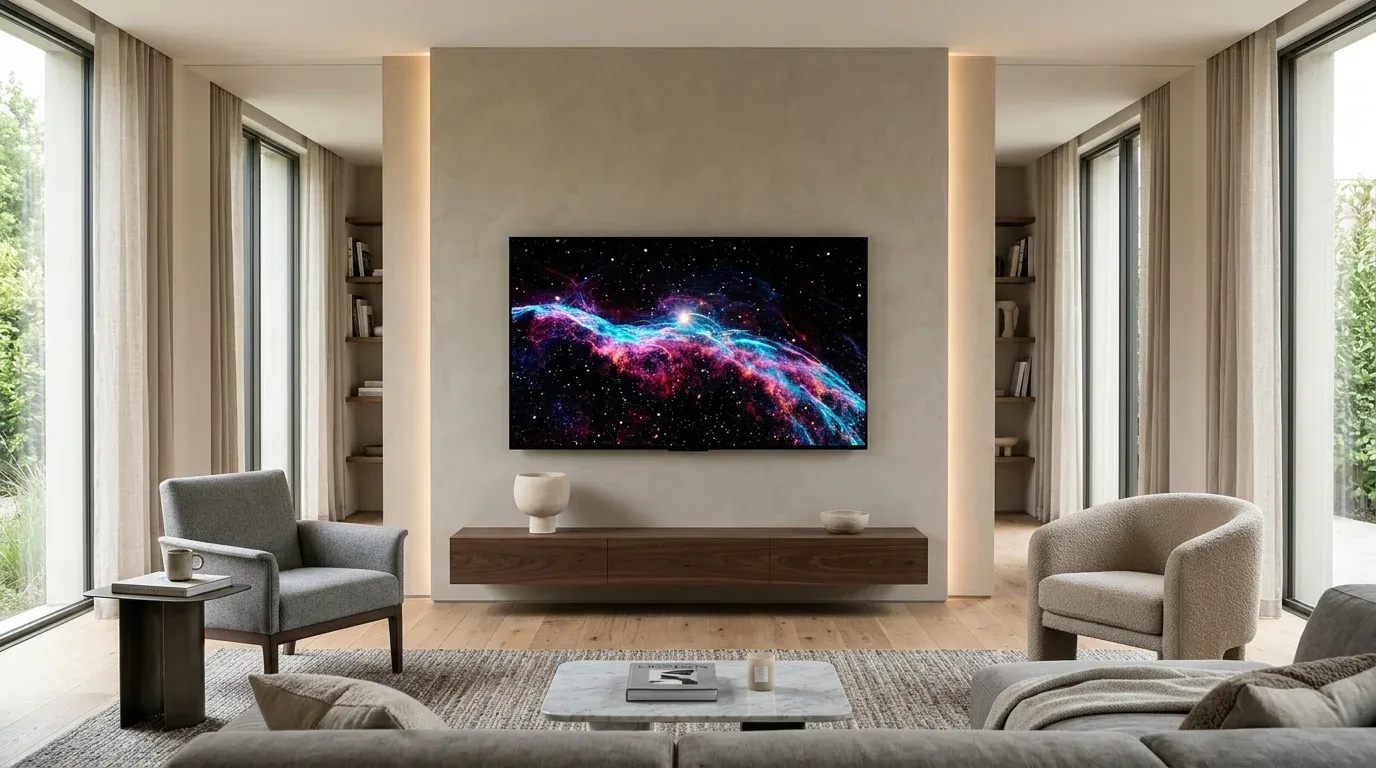
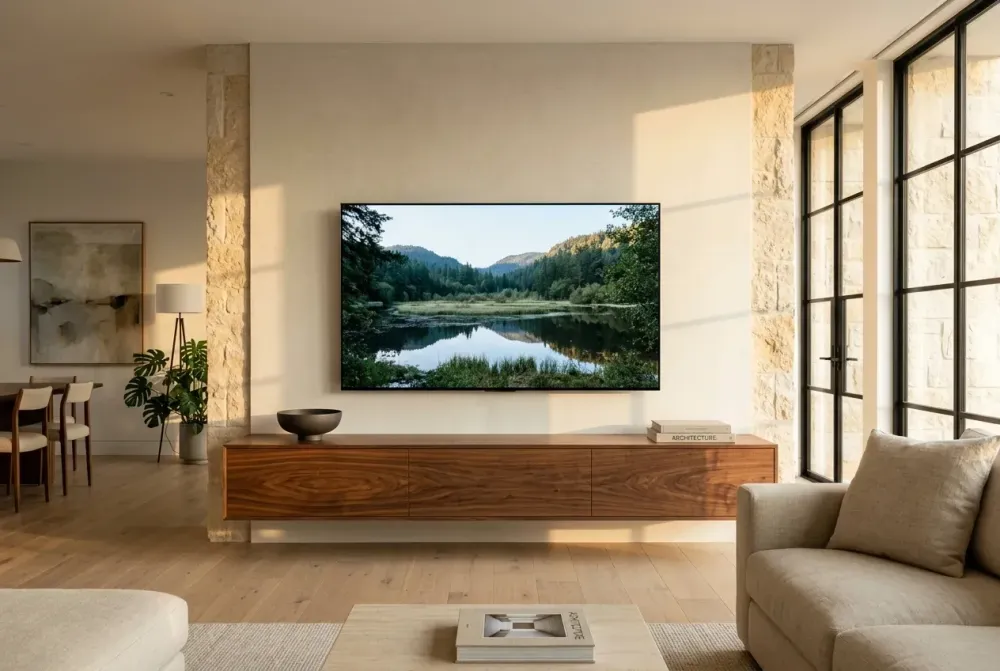
Suggested Alt Text: luxury living room featuring flush mounted 77 inch oled tv displaying vibrant 4k contrast on feature wall
The Names Are Confusing for a Reason
TV technology acronyms overlap because some describe the LCD panel, some describe the backlighting system, and others describe quantum-dot color-enhancement layers.
When shopping for a new television, looking only at the label can be misleading. The most practical way to choose between LED, QLED, OLED, and Mini-LED is to evaluate how each technology behaves in your specific room: black levels, peak brightness, daytime reflection handling, off-axis viewing angles, chassis thickness, panel fragility, and wall-mounting requirements.
Ready for Professional Setup?
Get a free, no-obligation estimate from local certified technicians in the Greater Houston Area.
Breakdown of the 4 Major TV Display Technologies
1. Traditional LED / LCD
Most standard "LED" televisions are conventional liquid crystal displays (LCD) backlit by light-emitting diodes arranged either along the screen edges (edge-lit) or directly behind the panel (direct-lit).
- Pros: High value, available in budget price tiers and sizes up to 85"+.
- Cons: Limited contrast, grayish blacks in dark rooms, and noticeable blooming around bright subtitles.
2. QLED (Quantum Dot LED)
Pioneered by Samsung and widely used by TCL and Hisense, QLED introduces a microscopic quantum-dot filter over a standard LED-backlit LCD panel to expand color volume.
- Pros: Vibrant, saturated colors and strong overall brightness.
- Cons: Because it still relies on an LCD backlight, black-level performance depends entirely on the quality of its local-dimming zones.
3. Mini-LED
Mini-LED is an advanced evolution of QLED/LCD backlighting. By replacing hundreds of bulky traditional LEDs with thousands of miniature LED diodes grouped into hundreds or thousands of localized dimming zones, Mini-LED delivers exceptional light control.
- Pros: Massive peak brightness (2,000 to 4,000+ nits) that overpowers severe room glare, deep shadow control, and zero risk of burn-in.
- Cons: Premium panels can be noticeably thicker and heavier than paper-thin OLEDs.
4. OLED (Organic Light Emitting Diode)
Unlike LCD-based screens, OLED panels are self-emissive—meaning every single pixel produces its own light and color, turning completely off when rendering black.
- Pros: Infinite contrast ratio, true inky blacks with zero blooming, and perfect viewing angles from any seat in the room. Razor-thin panel construction.
- Cons: Lower overall peak brightness than flagship Mini-LEDs; demands controlled ambient lighting to prevent reflections.
Contrast, Black Levels & Blooming: How Light Control Works
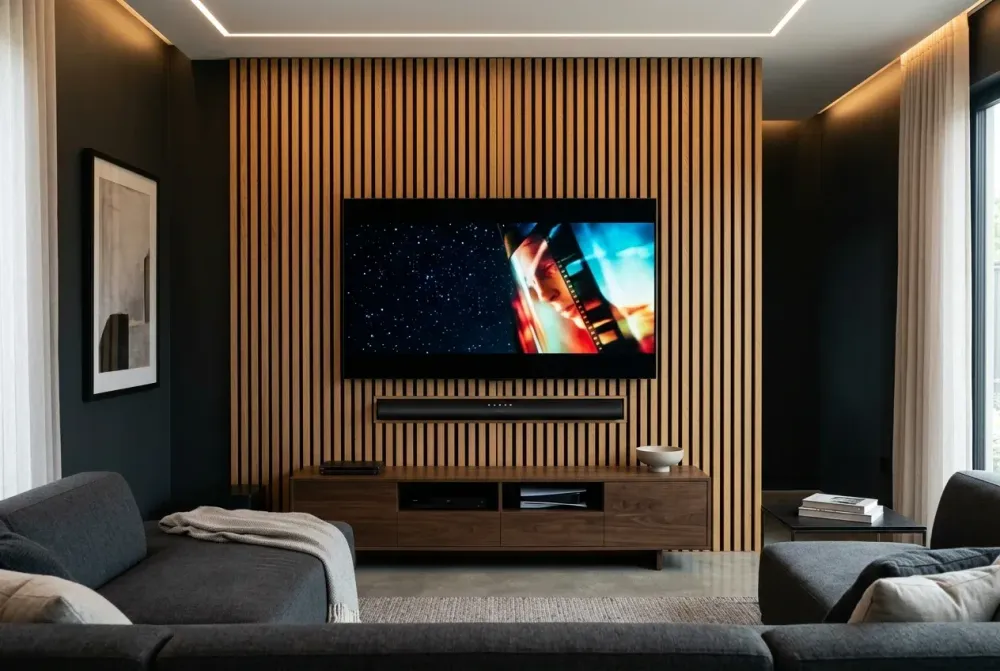
In a dark home theater or bedroom, contrast is king. Because traditional LED and QLED backlights cannot turn off individual pixels, bright objects against dark backgrounds (such as stars in space, streetlights at night, or white movie subtitles) bleed light into surrounding areas, creating an unwanted halo effect known as blooming.
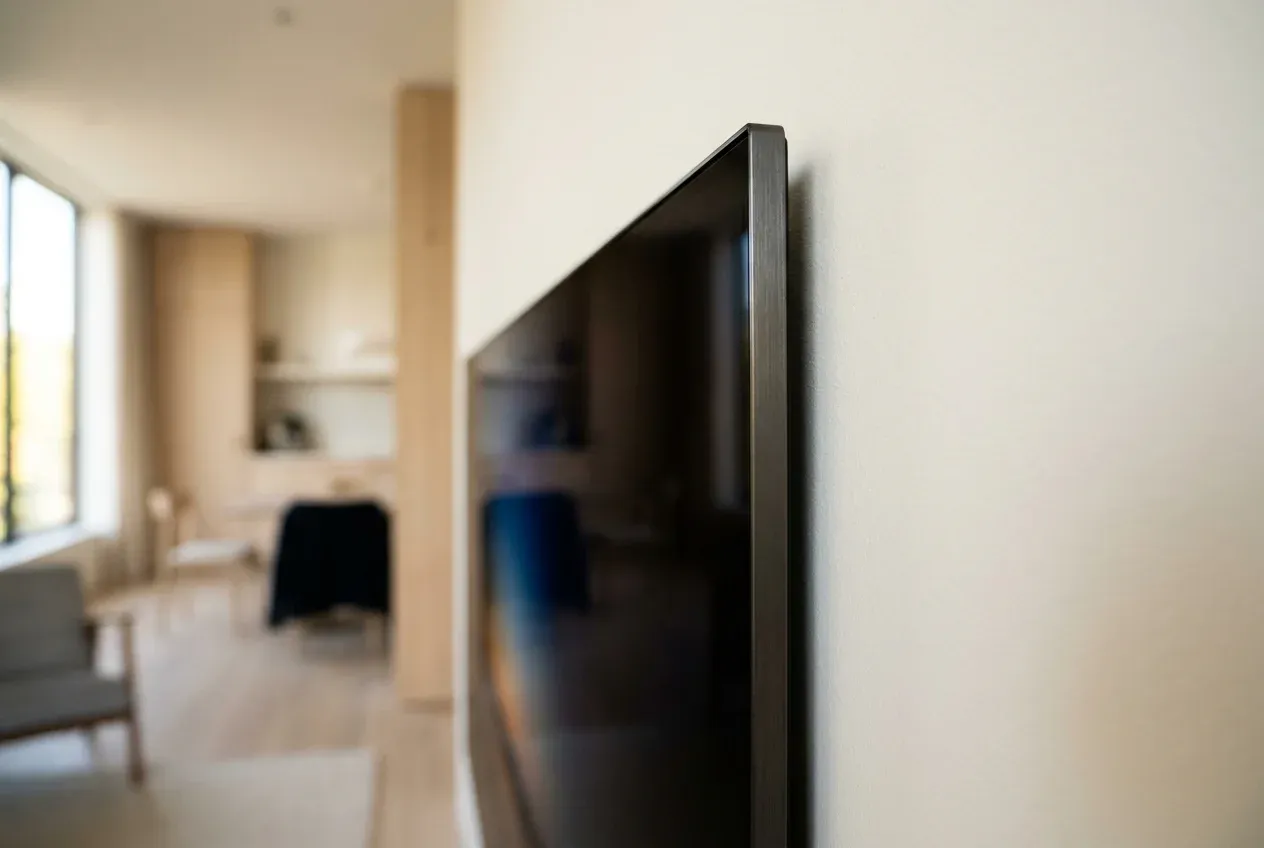
Suggested Alt Text: extreme close up side profile view of paper thin oled tv display mounted completely flush to wall
OLED solves this entirely at the hardware level: when a pixel is black, it produces zero lumens. This delivers unmatched three-dimensional depth in cinematic movies and prestige television dramas.
Brightness, Reflections & Real Room Performance
A showroom floor with controlled spot lighting rarely mirrors your home. If your television will face south-facing picture windows, open sliding glass doors, or strong overhead lighting:
- Mini-LED & Premium QLED: These displays excel in bright, sunlit family rooms. Their intense light output punches through glare, keeping sports broadcasts and daytime news crisp and readable.
- OLED: While flagship models (such as the LG G4, Samsung S95D, and Sony BRAVIA 8) have boosted brightness significantly, dark-scene details can still be compromised in direct midday sunlight.
Panel Choice Affects Installation Style and Wall Mounting
Choosing a display technology directly impacts how the TV must be handled, anchored, and integrated on your wall.
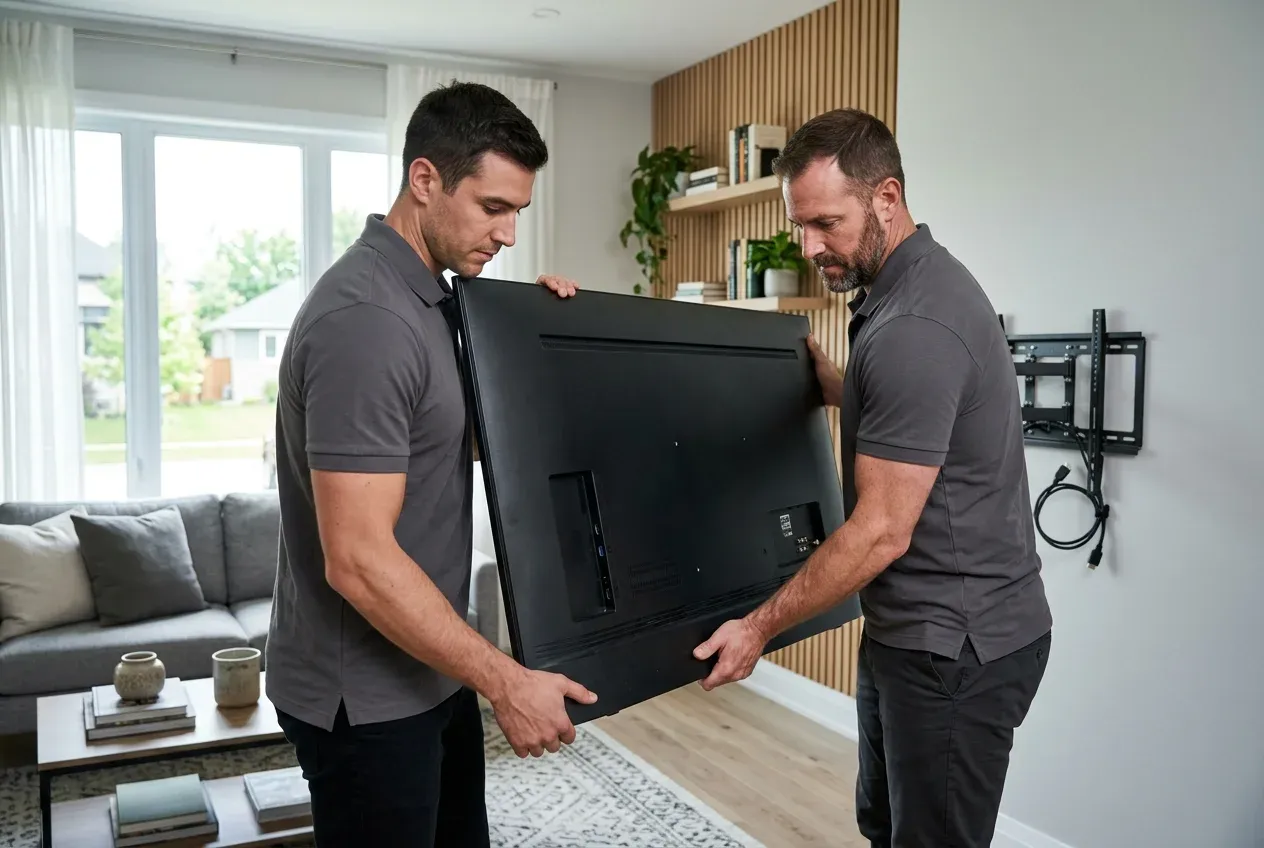
Suggested Alt Text: two professional tv mounting technicians safely holding and lifting a fragile large screen tv during wall installation
Delicate Handling for Ultra-Thin OLEDs
Many OLED screens feature glass panels that are just 3 to 4 millimeters thick at the top edges. Improper handling during mounting—such as applying thumb pressure directly to the upper glass—can crack the panel internally before the TV ever powers on. Professional technicians lift only by the reinforced lower housing and VESA mounting bracket.
Flush Architectural Mounting
- Gallery-Style Displays: The LG OLED G-Series (Gallery Edition) and Samsung The Frame are designed to sit virtually zero-gap against drywall. However, achieving this look requires precision planning for recessed media boxes and in-wall power outlets so cables do not push the screen outward.
- Mini-LED Chassis Depth: Because Mini-LED arrays require robust heatsinks and multi-zone LED backplanes, panels can weigh 20–30% more and sit slightly deeper. On full-motion articulating mounts, this extra weight multiplies leverage on wall studs, requiring heavy-duty steel lag bolts.
Which TV Looks Best Above a Fireplace?
Mounting above a fireplace introduces unique challenges: elevated viewing heights, upward heat convection, and masonry surfaces (brick, stone, tile).
- If your fireplace is in a bright room, a high-output Mini-LED paired with a tilting or pull-down MantelMount ensures comfortable sightlines and vivid picture.
- If aesthetics matter most when the TV is powered off, a matte lifestyle display (like Samsung The Frame) or an ultra-slim flush OLED blends seamlessly into architectural stone surrounds.
Which Screen Is Best for Multi-TV Media Walls?
For a multi-screen 4-TV or 6-TV sports den, visual consistency is critical:
- Choose identical panel models to guarantee matching color temperatures, refresh rates, and bezel thicknesses.
- High-efficiency QLED or commercial-grade LED panels are typically preferred for video walls because they offer uniform brightness, withstand long continuous runtimes, and maintain low operating temperatures.
The TVPro Perspective
There is no single "best" television technology—only the best television for your room, your lighting, and your family's viewing habits.
At TVPro, we evaluate your wall construction, lighting conditions, seating layout, and audio configuration before recommending an installation plan. We pair each display with certified structural hardware, conceal every cable inside the wall, and protect your investment with a 5-year installation warranty.
️ Ready to Mount Your New OLED or Mini-LED TV?
Need certified TV mounting, recessed box installation, and 100% hidden wires? TVPro delivers professional installations with same-day appointments available.
FAQ
Does QLED mean OLED?
No. QLED is an LCD-based panel that uses a backlight filtered through quantum dots for enhanced color. OLED is an entirely different self-emissive technology where every pixel produces its own light.
Is Mini-LED better than OLED for bright rooms?
Yes. Premium Mini-LED displays achieve peak brightness levels of 2,000 to 4,000 nits, allowing them to overcome severe sunlight and reflections that could wash out an OLED panel.
Are OLED TVs harder to mount on the wall?
Yes, OLED panels require extra care because the upper glass is paper-thin and fragile. Technicians must lift from the reinforced lower chassis to prevent twisting or cracking the panel during installation.
Which technology is best for flush wall mounting?
Gallery-edition OLEDs (like the LG G-Series) and art TVs (like Samsung The Frame) feature uniform chassis depth designed specifically for zero-gap wall mounting when paired with recessed in-wall media boxes.
Can Mini-LED TVs get burn-in?
No. Because Mini-LED uses inorganic LED diodes and LCD panels, it is completely immune to the permanent image retention (burn-in) that can theoretically affect OLEDs under extreme static-image conditions.